I recently took time to reflect over the busy week and weekend of music. From having just seen our Year 4 students start the journey of learning an instrument through the College’s Music Immersion Program, to working with advanced students from the Queensland Youth Orchestra (QYO), it was again confirmed that – despite being at very different stages of their journey – students need nurturing to continue to grow. I am attempted to share some insight into the journey for our new Year 4 families, I was reminded of an idea set out by Alfred North Whitehead back in 1929 in his book, The Aims of Education. [i] In this, he places ‘romance’, ‘precision’ and ‘generalisation’ as a ‘rhythm of learning’, the stages of acquisition of subject matter or skills (of course, they constantly spiral back through increasing stages of complexity). Good ideas in education tend to remain, gaining a sense of familiarity with time (that they seem so obvious to us today is, in part, proof of their value).
I intended to use Whitehead’s ideas in some other work, after having aligned his ‘rhythm’ to the growth of a tree – ‘romance’ as where the roots took hold in fertile soil, ‘precision’ as the persistent reach of the trunk toward sunlight, and ‘generalisation’ as the widening coverage of the branches over the ground from which the tree grew. A stretched analogy, but one perhaps you will entertain… the growth of knowledge and skill, and one in which we are as teachers and parents are the ‘gardeners’. Now, this was referenced by someone else in a discussion I had quite some time ago (I cannot for the life of me remember who or even where!), and I have reframed this idea to ‘fit’ music education. If, by chance, the original ‘analogy-maker’ is in the room, please stand up (and accept my thanks and appreciation)!
At this moment, our Year 4s are very much at the stage of ‘romance’, their interests taking foothold in the soil; they explore, ‘dig around’ and establish some foundations for growth. It is at this stage that we need to invest considerable time – young trees (or seeds) need to be tended to and ‘encouraged’ to grow; without our continued nourishment, they will fail. Sharing kind words of encouragement, showing genuine interest, and the valuing of learning an instrument provide fertile grounds for our students to ‘seed’. Given the right conditions, the following stage, that of ‘precision’ in learning, may be likened to the reaching of the trunk; the tree focussing its energy in one direction – upward. Students gain fluency and become increasingly precise with their knowledge use and in their actions – things become labelled and ‘known’, though importantly, this is still fed by fertile ground. From these two stages comes ‘generalisation’, a synthesis of knowledge and skill that can be then applied in new contexts – the reaching of the branches from the trunk out across a wider domain. From one ‘trunk’ can come many directions of application of the same knowledge, reaching as far as the strength of the root system allows (all the stronger the more we have tended to it in from seed). Now, on that stretched analogy… I am not giving anywhere near the detail that Whitehead did but do hope the essence of his idea remains intact.
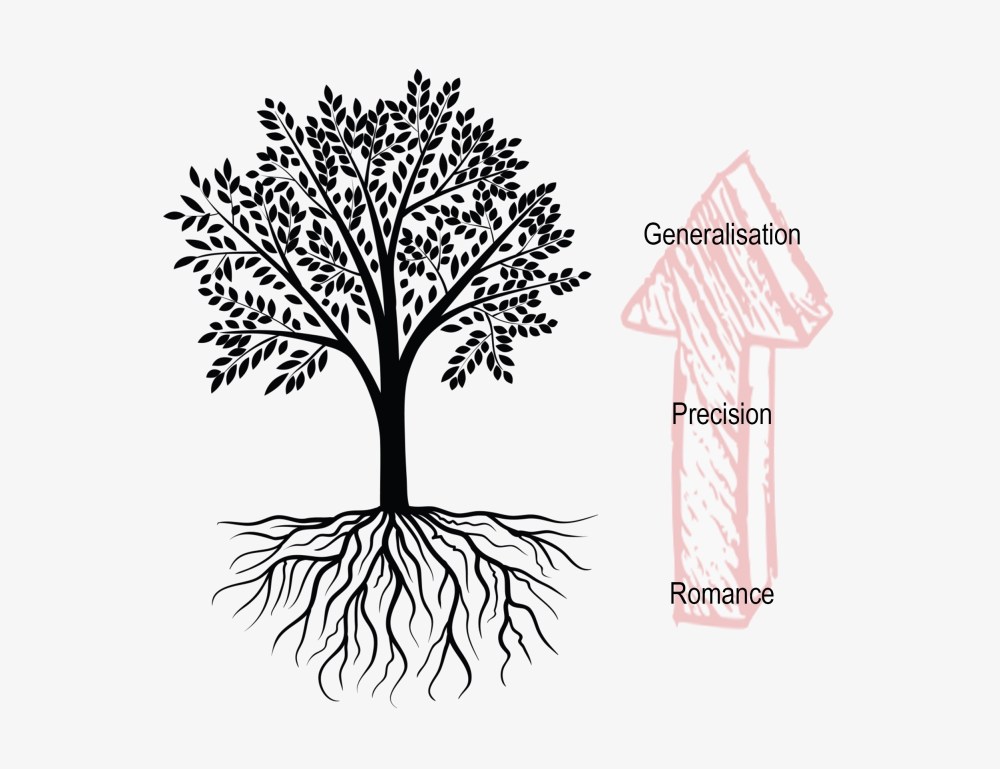
Whitehead’s ‘rhythm’ becomes apparent as we see a return to ‘romance’ with added competence – students fall in love with the challenge all over again and want to know and be able to do more. The Queensland Youth Orchestra students were once our Year 4s. They were nourished as young ‘seeds’ – encouraged by their ‘gardeners’ – grew mighty ‘trunks’ and now have ‘branches’ extending far and wide. The more they come to know, the more they want to know, motivated by ‘romance’, ‘precision’ and finally ‘generalisation’ of their knowledge and skill. They are very much entrenched in the ‘rhythm of learning’…
Back to our new Year 4s, ‘romance’ might not be the first word you think of after the first weekend of a student having a new instrument at home, but give it time, nurture it, encourage it to grow… and soon we will have a beautiful ‘tree’. If exploration and experimentation is encouraged at home – decoding the music together, together scheduling several short practice sessions each week, encouraging performances for friends and family, packing the instrument and case the night before rehearsals/lessons in readiness… then these little ‘investments’ pay off in the long run; we reap what we sow. It is at this stage that we all need to keep the energy and excitement high and celebrate the many musical, cognitive, physical, social and emotional benefits brought about through engagement with music.
Once the seed has been planted, it is up to us to assist the ‘tree’ grow.
i. Whitehead, A. N. (1929/1957). The Aims of Education: and other essays. The Free Press.
Image credit: iStock_000012181084

 Dr Cade Bonar