If you follow this site, then you might be aware of my thoughts on teaching music analysis and evaluation (mainly, in the context of the Musicology ‘strand’/component of Year 11 and 12 Queensland syllabus documents[i]). I’ve posted a few entries in the last year or so that attend to this, with the later of these essentially detailing a procedure for musicological thinking – a flowchart, or ‘mental model’, for the analysis and evaluation of music. Having since started the Integrated Project with my current Year 11s, I have further contextualised this mental model in an attempt to support them as they navigate the cognitive processes[ii] involved. The framework is the same, but there is a little more detail in the workings. You can view the new version below, or you can click here to download.
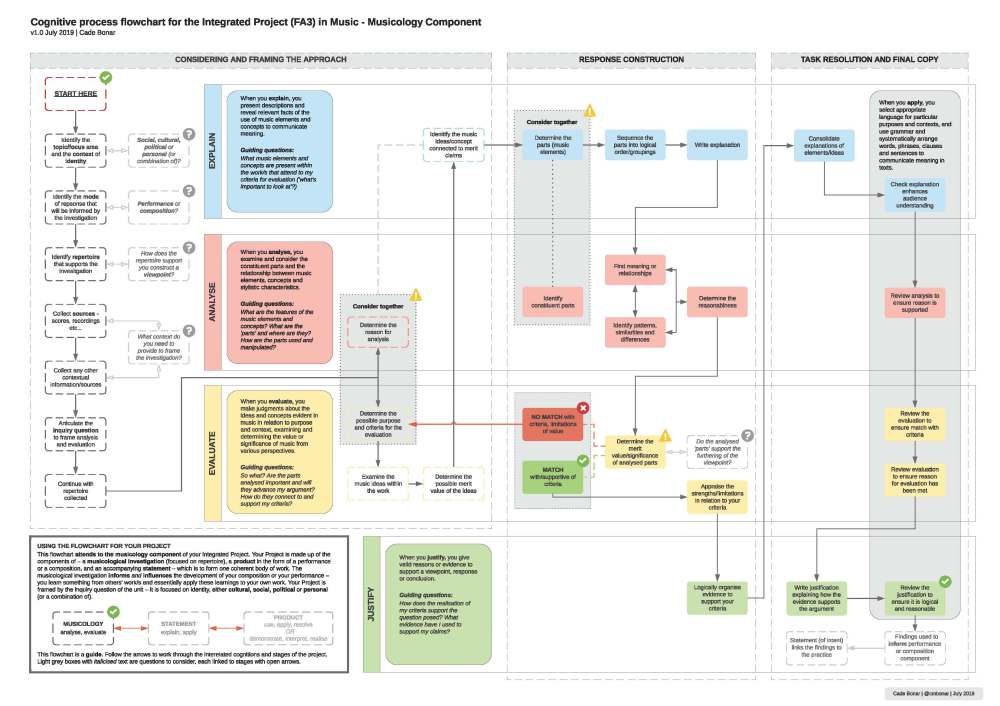
I have received quite a few questions about the use of this with students – and yes, this is something I give to the students in this format. Of course, it isn’t a case of passing it out and leaving them to decode it themselves – much time and care is invested into clarifying definitions, unpacking the model in stages, working though examples, critiquing existing work etc… Without breaking it down into its ‘parts’ and applying processes to, well, processes, it quickly becomes overwhelming (and, this is only one of the components of the Integrated Project!).
So far this term, the students and I have already navigated the first grey column, and now we are in the all-important ‘framing’ section of the process – setting up an evaluative criteria. I’ve written at length about this before, but essentially for any evaluation to occur, we need to measure ‘analysed parts’ of the music against an established criteria. This is why, as we enter the coloured sections of the model (in the ‘pre-task considerations’ section), we are immediately faced with a need to identify the purpose for the analysis, a purpose and criteria for the evaluation, and preliminary identification of possible musical components of potential value. This, of course, hinges heavily on the inquiry question posed – and together, the stages to be considered here offer a frame for the construction of the response. No mental model is perfect, however, and there are limitations here in the representation of the ideas – the stages discussed (pictured below) happen near-simultaneously – they are iterative, and we cycle through options and possibilities as we attempt to progress (hence the dotted-line returning to the grey box).
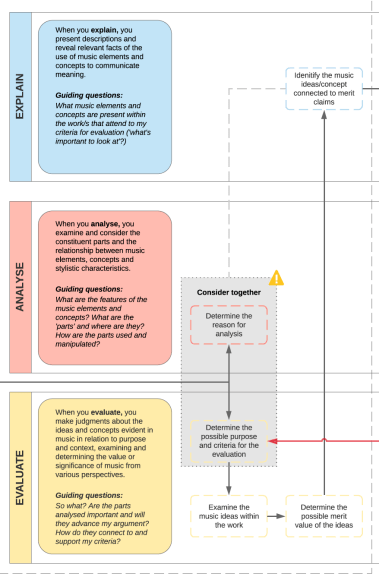
There is a lot of work to be done in this early stage; much work happens conceptually – we test possibilities. The importance of the inquiry question here is central – it gives reason and purpose to our analysis. The inquiry question is the overall bearer – it supports our criteria, our analysis and evaluation, and eventually the justification of our viewpoint.
In relation to the new (contextualised) mental model, one of the ways in which I break this stage down and make it more accessible is through the analogy of a ‘bag rack’. Our bag rack comprises a support beam, hooks and bags.

Within this analogy, our inquiry question is the main support beam. As I’ve already stated, this bears the weight our analysis, evaluation and justification. Our question needs to be robust enough to withstand the weight of the ‘hooks’ and the ‘bags’ that will be hanging from them. After the inquiry question is positioned as the frame for investigation, the next biggest consideration is the ‘hooks’ – our criteria. The definition of the word ‘criteria’ must be fairly broad as so not to be problematic or unnecessarily limiting – in this context a criteria might be an association, an expectation, the characteristics of a style or genre, even the qualities of a person, place or ‘thing’ (in the unit context of identity). As ‘hooks’, these criteria hold ‘bags’ of analytical parts, which contain our ‘evidence’ and support the claims we intend to make. We collect ‘like things’ and place them in the respective bag and then upon the hook that attends to the criteria in question. Our bags can hold any number of things and different types of these things – it is a thematic grouping of interrelated elements, concepts and devices. We only put things of worth in these bags – things that support our criteria; things of value.

Many of the students are now moving from this stage of the model and into constructing the middle section of the model (see ‘response construction’). Here they are beginning to amass a bunch of ‘analysed parts’ into their various ‘bags’. It is at this stage that they will need to be discerning as to what it is they have placed in each. We really only know of the true value and potentially supportive nature of the analysed ‘parts’ once we have subjected it to this more rigorous level of critique. It is at the end of this stage of analysis and evaluation that we get a greater sense of value and significance of these parts in attending to supporting our viewpoint. If something doesn’t quite ‘fit’ in our bag and therefore does not belong on our ‘hook’, then we discard it – it is of no value (or lesser value that other things) and therefore not needed. This is the stage represented below – it is a significant point of decision-making and draws to attention ‘what matters’ in supporting the viewpoint.
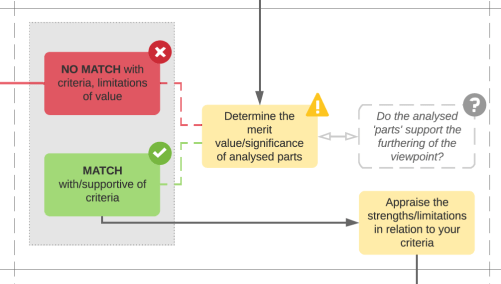
I’m likely to have stretched yet another analogy too far, but it did seem to assist the students make sense of the need to be discerning as to their selection of ‘parts’ to analyse. The most challenging part for many of them was deciding on what type and how many ‘hooks’ to use! Once that was established, however, the students seemed more comfortable packing their ‘bags’ in a more focused and meaningful way.
[i] This refers to both the 2013 and 2019 documents, which contain similar cognitive processes in Musicology.
[ii] As I’ve made clear before, these models draw from the QCAA Cognitive Toolkit resource (well worth exploring in itself).

 Dr Cade Bonar
One Comment Add yours