The implementation of the new QCE system[i] has seen significant change to Year 11 and 12 assessment and a reframing and reshaping of the curriculum in each subject. In the case of Music, the framing of the curriculum may have changed, but as I have argued before, it is still set upon the same musical concepts and processes. When we ‘music’ we apply process to concept, and I would hope that the teaching of musical concepts and processes is considered central to any and all musical experiences we have our students encounter. These experiences, of course, are framed by context and guided by the inquiry questions we pose. Between concept, process and purpose we have or our ‘what’, ‘how’ and ‘why’ respectively; each of these must be considered when we are designing teaching and learning for our classes – they each rest upon and draw from one another as students construct meaning.
For me, the ‘what’ – musical concepts – has always been present in my curriculum design, organised within units of work and explored through teaching and learning plans (I have previously shared a simplified overview of concepts from Prep to Year 12, and am currently working on a more detailed update in readiness for the new school year). The mapping of these concepts remains reasonably fixed as the concepts of music are static; these concepts and foundational knowledges are fundamental to the nature of the music itself, irrespective of style or genre[ii]. It is within ‘context’ that we see flexibility in the delivery of the ‘what’; the application and utilisation of these knowledges must be constantly considered and evaluated for purpose as contexts around us change. All music is valid for study if what is examined is the musical ‘what’.
Before now, the ‘how’ – musical processes – were somewhat buried in teaching and learning experiences and assessment – there, but perhaps not as clearly articulated. When we composed, for example, we drew upon compositional practices and processes, such as combining and manipulating the elements of music[iii]. Now, this is essentially what it is we do when we compose, but the new syllabus[iv] brings process to the fore. To stay on the theme of composition, these processes define a ‘cognitive workflow’, in at least as far as this is possible – as composition really isn’t a linear process (this is another post in itself, though I have considered this in relation to music analysis and evaluation). The entire suite of processes of the new syllabus underpin the ways we engage with music – ‘how’ we as ‘makers’ and ‘responders’ work with the ‘what’.
Until recently, the ‘why’ – the purpose – for me was less considered, even misplaced[v]. The ‘why’ often formed a curriculum rationale, focused on my own intents and purposes with the content. I knew why I was doing what I was doing from a curriculum standpoint, but – in keeping the construction of meaning central to our classroom interactions – did my students know why I was doing what I was doing? What meaning did the ‘what’ and ‘how’ have and hold for them? What do they see as the purpose? Considering this offers greater focus and connectedness to the ‘what’ and ‘how’ and assists in the construction of meaning. What is the purpose and value of this knowledge for our students in the ways they use it? This continues to be a constant question!
A clearer articulation of the ‘what’ and ‘how’ in the new syllabus offers a defined target to aim for. The ‘why’ is also framed by the inquiry questions for each unit, as well as in the central focus of the syllabus itself – the manner through which music communicates meaning, and the ways we use it to communicate meaning. With a ‘what’ and ‘how’ destination set (and the overarching ‘why’), we can begin to map our journey. We know where we need to get to, and we backward map from there, finding the best waypoints and pathways along the way.
We have recently extended the mapping of concept, process and purpose back into the Year 7 classroom. This was motivated by ensuring connectedness and alignment through the curriculum given the new syllabus, and also after wrestling with the ‘why’ question in relation to students’ meaning-making and valuing of the tasks at hand. A clearly articulated ‘why’ question is very much necessary here, when these compulsory classes comprise students with considerable differences in abilities and experiences. The Year 7 classroom has plenty of ‘characters’, and we must ensure that our educational aims and purposes attend to all – music is for all, and all musical ‘voices’ need to be encouraged to grow. Further, these ‘voices’ need to be encouraged to say what it is they wish to say in terms of expressing meaning and identity. This attends to the fundamental purpose of music. The considerations here influenced the development of our new Year 7 unit, What’s My Motif?, which is focused on the way in which music communicates identity (of the ‘characters’ in the classroom!).
Across the term, the classes focused on how characters were conveyed in film through music, examining the ways in which music can ‘tell us how to feel’ and ‘what to think’ about the character, and how it outlines ideas and actions. Music is very telling here; it can reveal much more than what visual images convey alone. We then turned to motifs – a musical idea associated with a character – examining characters from The Avengers, Batman, and Star Wars (there is some really wonderful music you can use here to explore the concepts – particularly, the minor third in The Dark Knight, not to mention the use of compositional devices in this simple yet effective 2-note theme, as well as the familiar intervals within Star Wars…). We engaged with these themes in terms of listening to them, playing them, and then asking questions of them. We looked at the music elements – the building blocks of all music, our planned concepts – and how they were used and manipulated to convey character. This is the ‘what’ – they ways in which we work with foundational music knowledges. We also looked the compositional devices used by composers and how they can assist to create unity, contrast, development, transition and variation, and provide accompaniment and thematic organisation – this is the combination and manipulation of elements.
The summative assessment of the unit focuses on composition. The task itself is essentially the composition of a ‘motif’, which is designed to attend to the ‘what’, ‘how’ and, importantly, ‘why’. In attending to purpose, we draw the students ‘voice’ to the fore, asking them what their motif would ‘say’ or reveal about them and their character, influenced by their ‘character strengths’/profile from their own VIA Character Strengths[vi] survey, which was competed in their My Wellbeing class[vii]. Questions as to what their melody would ‘say’ about them, and considerations as to what music elements could be used to convey this were proposed, ‘played with’, reflected upon and used. The students were given guidelines for their composition, but ultimately, to respect all ‘voices’, they could say what they wanted. After all, it is they themselves they are reflecting musically. As long as decisions are linked to intentions that can be explained, then every motif has validity. Working in this way gives purpose to musical activity and attends to our ‘why’ question – students see personal meaning and connect greater value to the task.
The task description reads:
You are to compose a motif (in this context, a musical idea connected to a character) that identifies you and your ‘character’ – you might like to think of it as your own ‘theme song’ melody.
Your motive is to be in the major key of C, G or F, or the minor key of A, E or D. You can use any time signature/meter and any rhythms you choose. It is recommended that your motif be between 4 and 8 bars in length and have at least a melodic and supportive accompanying part.
Your composition is to be influenced by the qualities that you see in yourself. Are you ‘energetic’ and ready to ‘leap into action’, or are you more of a ‘calm’ type…? This will influence how you use music elements and apply compositional devices.
You are to submit this task as a single PowerPoint slide on Canvas. You are to include the following parts: a) your name and picture of yourself ‘in character’, b) a list of the ‘qualities’ of your character, c) an audio recording of your composition embedded into the slide, and d) a statement of intent based on the questions below.
The statement of compositional intent is guided by scaffolded questions embedded on the task sheet. In it, the students explain why they used particular music elements and applied specific compositional devices. They are written statements of approximately 100 words and serve to connect analytical knowledge with compositional output – they are a bridge between the intuitive and the analytical. The questions posed are:
What tonality/key did you choose for your motif, and why did you choose this?
What rhythms did you use and why did you use these?
What are the features of your melody (pitch, contour/shape, steps/leaps) and how does this help connect to the ‘qualities’ of character you identified?
What compositional devices did you apply to making your melody?
How effective do you feel your melody is at communicating your ‘qualities’ of character?
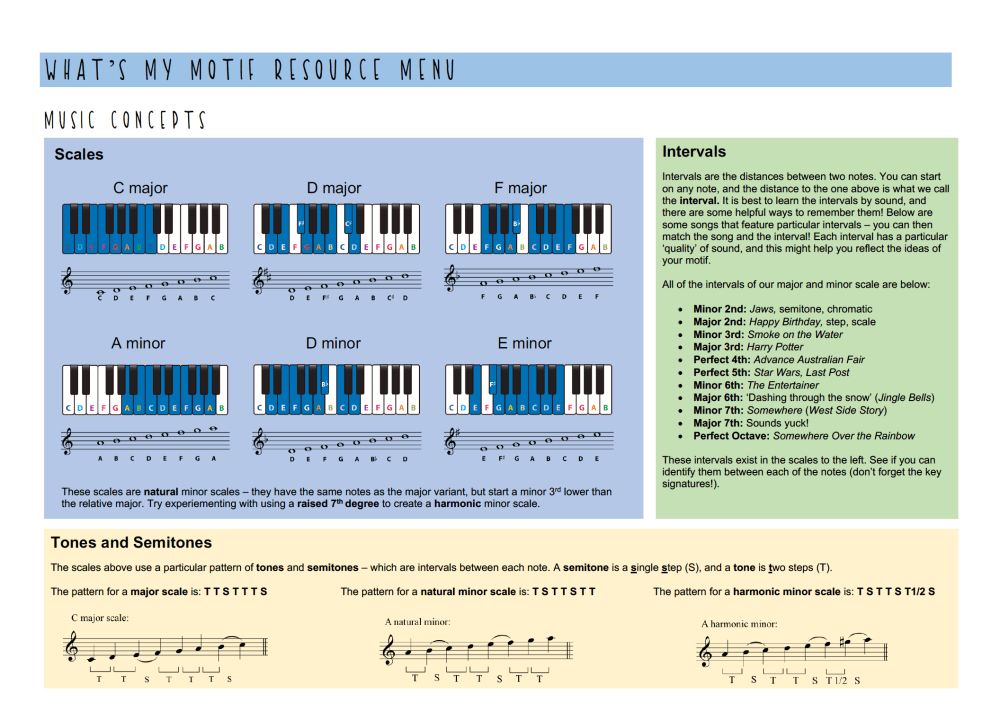
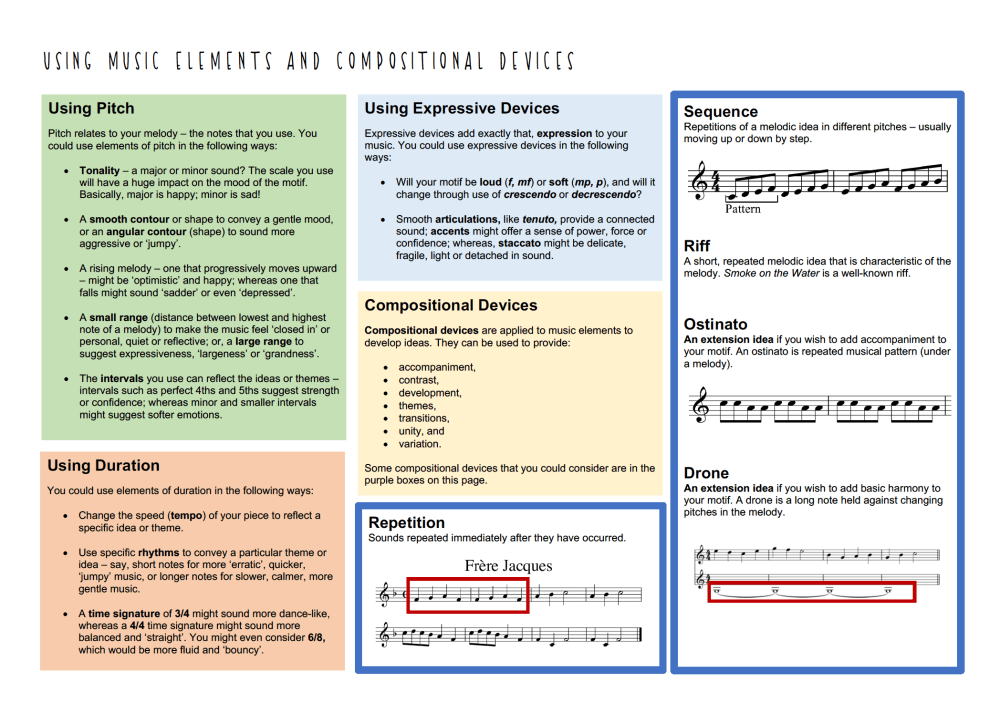
As the students work through the task, they are provided with a ‘summary’ of the concepts to assist the compositional process. I came across this idea from Mike Morgan (@MikeMMusicEd), and with his permission developed one for our new unit. We call it a ‘resource menu’, and from it, students select items to employ – our concepts, or the ‘what’. This also acts as a useful summary sheet of the subject matter covered in the unit. A screenshot of the ‘menu’ is below, and you are welcome to take a closer look on the ‘Resources’ page (here).
With the alignment of the ‘how’, in this task we work with the same musical processes in composition as the Year 11 students – use music elements and concepts, apply compositional devices, and resolve music ideas, alongside explaining the use of music elements and applying literacy skills to communicate compositional intent in a written statement – it is essentially a matter of depth and complexity in relation to the product. These processes are clearly defined on the task sheet and unpacked in class. As discussed before, these processes are fundamental to composition, and are defined for the students as:
use – when you use music elements and concepts, you identify, select and combine them in the compositional process
apply – when you apply, you use your knowledge and understanding of compositional devices to create a composition
resolve, explain and apply – when you resolve, you express music ideas to consolidate and communicate meaning in composition; when you write your statement of intent, you explain relevant facts of music elements and apply appropriate language conventions.
The grouping of ‘resolve, explain and apply’ relate to the communication of the compositional idea as a whole – it integrates making and responding and ultimately assigns analytical meaning to music and the musical decisions made.
The task evidences the ‘what’, ‘how’ and ‘why’, and links through to the new syllabus. The processes are the same, and the concepts focused upon underpin the concepts students will encounter in the following years (and as mapped here). As we have borrowed the processes from the new syllabus, and to attend to the ‘linearity’ of how students are assessed through Year 7 to 12 (i.e. numerically, this is actually a school-wide approach), we have also contextualised the ISMGs[viii] from Year 7 through to Year 10. I appreciate that this might seem removed from the Australian Curriculum: The Arts document, but underpinning the curriculum, pedagogy and assessment are the ‘making’ and ‘responding’ strands (we also still report on the mandated, 5-point scale twice-yearly) – if we teach music musically, then we satisfy our brief. The ISMG we use for this unit can be found here as well. As you will see, the processes are the same and the marking guide has been manipulated to suit the task and the year level in question (please respect that this is identifiable by school and is in use at present).
At the conclusion of this unit, nearly 120 motifs were submitted across each of the classes – in many cases musical knowledge and purpose linked, greater connections to music forged through the explorations of ‘self’ and identify through music, and greater meanings found in music. This unit offers a sense of progression through the concepts, processes and purposes of music – a valid waypoint on the journey towards the new syllabus. I am sure that this will undergo considerable refinement before the next iteration, but good to air the ideas publicly and think out loud. Thanks, also, to my colleagues who actually taught this and offered critique and questions. If you have any questions or feedback on the unit, please feel free to contact me.
What would your motif be… and why?
[i] Queensland Certificate of Education (QCE).
[ii] At least in a Western sense. Music elements are the basic building blocks of music – changes and innovations in their use, is exactly that, in the way that they are used/combined.
[iii] ‘Combine and manipulate the elements of music’ is from the Australian Curriculum: The Arts – Music (Year 7 and 8) content descriptors.
[iv] ‘New syllabus’ as used in this post refers to the 2019 Music: General Senior Syllabus (Queensland Curriculum and Assessment Authority).
[v] The ‘why’ was posed to me be a new colleague working in Year 7 Music. Her continued questions have been very much welcomed and always make me think!
[vi] VIA Character Survey – https://www.viacharacter.org/ – our students complete this as part of the pastoral program at the school.
[vii] My Wellbeing is a pastoral class focused on several topics that underpin students’ health, awareness and well-being as they negotiate school.
[viii] ISMG – Instrument-specific marking guide.

 Dr Cade Bonar