This is a summary of my presentation for the ‘Preparing Students for the External Assessment (EA)’ hosted recently by ASME Qld.
My thanks to ASME Qld for allowing me to share some ideas about preparing students for the approaching External Assessment (EA). There are many of us with ideas that effectively assist our students respond to the demands of the EA, and I feel privileged that I have the opportunity to share some of mine.
As I mentioned in the workshop, our students’ preparation for the External Assessment (EA) essentially begins with their very first musical interactions; whenever we engage in music/musical practice we are working with music elements, features, devices etc… We need to monitor our approach to providing students with the ‘experiences’ that ready them for the EA, ensuring that we don’t remain ‘one-dimensional’ and focused upon listening/responding and exam style questions alone. Of course, this type of preparation is of great value, necessity, and importance, but there is much to be gained if we continue to work in and with music itself. Essentially, we are aiming to equip students with the ability to ‘talk musically about music’ – we are developing their musical vocabulary and their fluency to engage in musical ‘language’ use; making discrete components conscious and connected through musical practice – akin to the way in which we learn to talk when we are young; in constant use in practice – and shift from the discrete to the conversational with their use. This is a long-term, evolutionary process if it is to have significance and meaning.
What follows are some of the approaches that I take to assist EA preparation that I shared at the workshop. I have tried to show a balance of ‘making’ and ‘responding’ activities, though whilst there are only three making-focused activities, they are perhaps a little more involved. We do still sing and/or play everything we study that we can, but here are some approaches/resources that I find are easily translatable.
- ‘Associations – what is the music saying?’ (establishing themes/criteria)
- ‘Dry analysis’ (‘explaining’ music features)
- ‘Show me the money!” (detail expansion strategy)
- ‘Composition cookpot’ (composition with subject matter)
- ‘Hide and seek’ (composition to hide a known melody)
- ‘Play it alive’ (aural discernment of music)
- ‘Mental model of analysis and evaluation’ (the relationship between analysis and evaluation)
- ‘1:2:4 Butterfly’ (planning and building evidence)
- ‘The EA Collective’ (generating stimulus and question/cognition literacy)
I’ll (try to) briefly unpack each in turn.
‘Associations/meaning – what is the music saying?’
I constructed this quite a while back when I did a unit called ‘Evocations’ with my Year 12s. We were focused on the ways in which music conveys emotion and meaning, and found that our initial associations made to the expressive character of the work housed value and significance, offering a good place to start ‘asking the right questions’ of the music (purposeful and broader meaning-oriented questions). I use this today to assist students locate the theme/s of a work, which provides a criteria for later evaluation and focuses our analysis.
Associations
Consider the narrative of the work and its associative power:
- What does it ‘say’ to you?
- What does it communicate?
- What words identify your interpretation?
Analysis
Connect these associations conjured by the narrative to identifiable/’point-out-able’ uses and manipulations of music elements and compositional devices.
- What music elements and compositional devices are used to create these associations?
- How do music elements interrelate and work in conjunction with each other?
Themes
Consider the synthesis of your findings:
- How can you report on your refined ‘associations’ (your themes)?
- How does a discussion on each theme support your evaluation?
- How do the findings align with your established criteria/expectations, and ultimately, the question posed?
I have written on this before, and you can also access this and the template I use here.
‘Dry analysis’ – explaining music features
This is a strategy I use in Year 11. It is a comprehension/retrieval activity, removed from the higher/more demanding cognitive processes such as evaluation. It does go against my usual approach in connecting/locating meaning, but I find it useful in working with the ‘raw’ music elements and compositional devices. It affords the building of discrete musical vocabulary in the students.
There are a few different ways in which I approach this:
- annotation on a shared document online (OneNote integration in Canvas), with each student adding in a different colour (single work)
- several extracts (different music, one per student) on A2/A3 sized paper stuck up around the classroom, and students move between them to add a response
The students continue to exhaustively ‘analyse’ the work (they are effectively ‘explaining’ here, but it provides a footing for their later analysis). It also assists convey the importance of knowing what is of value when placed in the context of a question/evaluative stance.
These approaches become a powerful formative tool and assist me in knowing where is best to move next with in responsive planning.
‘Show me the Money!’ – expansion strategy
Often connected/associated with the ‘dry analysis’ activity, but also a strategy to exhaust meaning (‘data’) – ‘show me the money!’ (show me the evidence) as a colleague used to say to his Humanities students. A response to a section, phrase, ideas… is posed by a student through questioning, and we build additional ‘information’ to this and add detail to the sentence, one/two units of information at a time. I will often project this on the screen in the classroom (just in a Word document), typing the additions as we do one together.
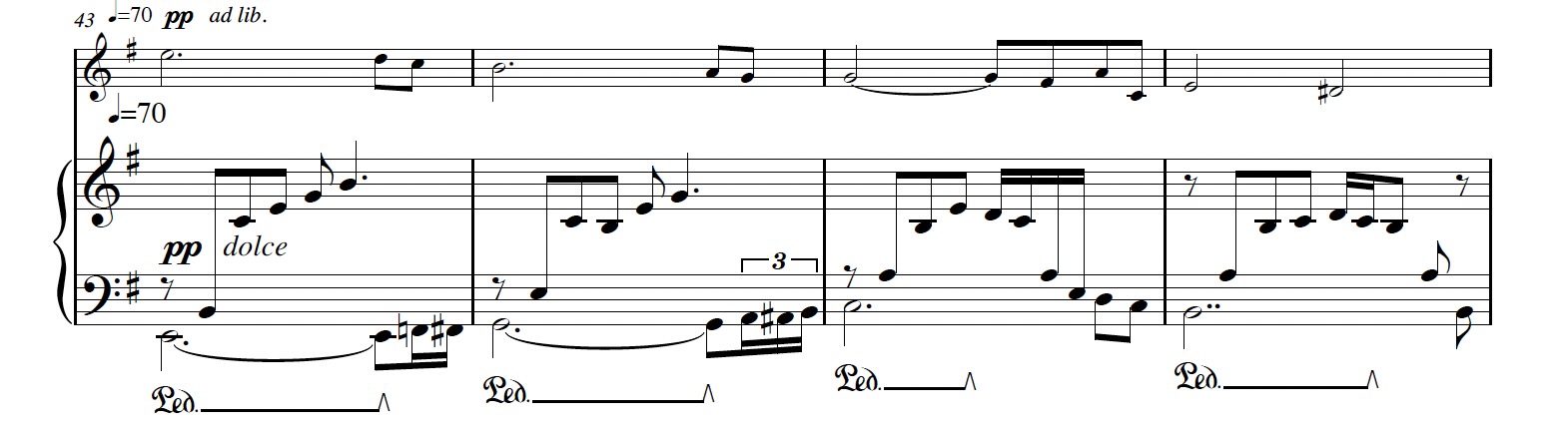
Using an extract from Piazzolla’s Café 1930, we might, say, focus on the melody to start:
- The melody falls from high E.
- The melody in the violin falls from E5.
- The violin melody falls from a dotted minim E5 down to a dotted minim B4.
- The violin melody descends from a dotted minim E5 to a dotted minim B4 through bridging quavers…
- The violin melody descends from a dotted minim E5 through bridging quavers, D5 and C5; this is repeated in sequence, starting on a dotted minim B4…
- The pianissimo violin melody descends from a dotted minim E5 through passing-note quavers, D5 and C5; this is repeated in sequence, starting on a dotted minim B4…
This can easily become a game, challenge… where students compete to add the detail. From there, the sentence expands to sentences… and perhaps to a paragraph. Again, we are building fluency, starting with discrete units. Foundational to this is the alignment of analysis to purpose and context; evaluation will frame, guide and direct this as we move forward.
‘Composition cookpot’ – composition with subject matter
I employ this strategy with Year 12s to keep music connected to ‘practice’, often after their IA3 is complete. Knowledge of music at its most fundamental, intuitive level can be drawn into ‘analysis’. We ‘get our hands dirty’ with the music elements and concepts; we attach meaning to these through experience with them.
Often, this strategy comprises 3 aspects:
- an element (focus element)
- a compositional device (focus device)
- an identity or narrative (depending on unit).
I have the students draw one card from each of three boxes containing each aspect above, and this becomes stimulus for a double-period composition. It is fast and frenetic – focused. They don’t need to be long or overly complex, just a complete idea. We then share and critique the work in the next period; the prominent (selected) element, device and identity/narrative is discussed and drawn into analysis and evaluation (its effectiveness).
‘Hide and seek’ – hiding a known melody
This is another compositional activity that I used to prepare students for IA2 and also employ post-IA3. Students are given a well-known melody (up to 8 bars) and they have to ‘hide’ it in a short compositional work. Greensleeves (trad.) is a good one to use, and students bury this in their music – they might transfigure the melody, obfuscating it in harmonic choices, changing its meter, or atomise the melody across parts. They often draw on a Year 11 lesson we do on motivic development, where we look at inversion, augmentation, diminution, fragmentation, retrograding… Students then share their work with the class we have to ‘find’ the melody amongst their work.
‘Play it alive’ – aural discernment of music
Born out of ‘lockdown’, I used this strategy with my Year 11 class – it was out very first interaction and proved rich in value. Essentially, in this strategy, we are focused in on engaging with music first-hand and the interactions between making and responding.
In the example above, we started with listening to Believer (Imagine Dragons). We engaged with the sound alone – there is no notational aspect provided. After some repeated listening, I posed the prompts below:
- What instruments (including voices and effects) do you hear in the song?
- What is the structure of the song? How many sections are there and what is the function of each? What instruments are present in each section?
- What is the meter (time signature) of the song? How do you know?
- What is the pattern of the clapping and main drum patterns you hear? What does this look like in notation?
- How many different chords are used in the song? How do you know? What are they?
- What is the key/tonality of the song? What are the qualities of the chords (e.g. major/minor)?
- What is the harmonic rhythm of the piece (how often/rhythm of the chord changes)?
- What is the rhythmic pattern of these chords in the song? Does it stay the same/change?
We discussed their responses, and drew connections to the piece, isolating examples aurally. From here, the students were to aurally discern:
- the lyrics and melody and sing
- the repeated arpeggiated/outline chord sequence and play on guitar or keyboard
- the ‘thickened’ dramatic electronic chords and play using your computer
- how the vocal effects might be achieved using your computer
- the drum and clapping parts.
We then workshop these ideas and processes (of discerning music), assign parts and practise – we ‘play it alive’. This way of working attends to working musically with music – we are starting with practice, developing, informing, and connecting our musical vocabulary through conversations, and starting with discrete units of information, and then building them into (hopefully) a fluent expression of the music ideas.
‘Mental model of analysis and evaluation’
This is a document that I use in IA3 preparation. Its use (reference to) again here shows the staged nature of these processes throughout IA1-3. For me, evaluation ‘sandwiches’ analysis. An evaluative claim is made, and a theme is positioned as a criteria; analytical findings are held up against these criteria, with the value of each analytical ‘part’ measured according to them. I have written on the development of this before, and you can access the model here: ‘Flowchart of cognitive processes’.
‘1:2:4 Butterfly’
This was a strategy born out of the 2020 EA, where two pertinent examples were to be located from each element. I used it with the 2021 cohort, and it provided a good structural/organisational piece for them during their planning time.
The 1:2:4 Butterfly provides 1 theme (body), 2 music elements/concepts (wings), and 4 pieces of evidence (two per element/concept, which are represented by the dots/colourings). The diagram below will assist with the design/function, and the file is available here.

Though the 2021 EAMG did not specify ‘amount’ of evidence located, I still currently use the 1:2:4 model to scaffold responses. This is a time-focused strategy – we are essentially looking at providing the most robust, commanding, pertinent ‘data’ on the wings (the ‘dots’). This process of evaluation sees us evoke ‘natural selection’ – the strongest evidence (the prettiest dot!) survives in your argument.
The ‘EA’ Collective
We do shared playlists called ‘Collectives’ in Year 11 and Year 12, where students add music aligned to the unit (Identities and Narratives work well) that they think I need to hear/they identify with. These ‘collectives’ are great in that it also exposes me to new music – there are always brilliant ‘finds’ that I often adopt (professionally and personally – many listen to great music!).
Recently, we used the ‘collective’ idea to generate additional stimulus for the Year 12s EA preparation. In a discussion thread on Canvas (our online learning platform), I pin:
In a ‘reply’:
- add a score and recording of a work that represents a clear narrative idea (link a file, website, YouTube/Spotify link)
- identify the theme (to frame evaluation)
- copy the question below and add the details required [in red]
- post!
Analyse and evaluate how [composer/artist] manipulates two music elements/concepts to communicate the theme of [theme] in [piece/work]. Justify your viewpoint by providing examples from the stimulus for each selected music element or concept.
This not only generates more stimulus for the students, but importantly gives them a deeper understanding of the EA style question and the processes demanded by it, as they have to ‘write’ it. I do monitor the thread to quality assure!
These are a few ideas that I have found successful in my context. I am sure that many of you approach the preparation in similar ways, but I do hope that there is something of value for you here too. Always happy to engage in discussion and share resources and approaches (though I will also keep some up my sleeve!), so please feel free to contact me.
Photo by Aaron Burden on Unsplash

 Dr Cade Bonar