The Music 2019 General Senior Syllabus[i] will be implemented in the new year in Queensland, Australia, though many teachers have long begun preparation for the transition into this new document (and indeed system). There are some big systemic changes to the organisation of curriculum and assessment in every Year 11 and 12 subject, though we must keep in mind that the nature of our subject will not change. We will continue to ‘music’ and work with processes that we currently employ. That one jurisdiction writes a new syllabus bears no impact on what music is, or how we engage with it – music is still, and will always be, music. If we teach music musically, we will at most only have to change some of the labels.
Like the Australian Curriculum, the new syllabus organises the broad processes we undertake in Music into the strands of making and responding. Making includes working in the art form with knowledges, skills, techniques and processes; whereas, responding is focused on working about the art forms and exploring, interpreting and analysing works.[ii] In Music, the making strand frames the processes of composition and performance, whereas the responding strand frames musicological processes. It is important to note the language used; composition, musicology and performance are ‘processes’, not objectives or dimensions of any one strand, and these processes underpin both the curriculum, pedagogies and practices, and assessment instruments of the new syllabus. It is made clear in both documents that these strands are interrelated. Or, they should be…
Often, however, these processes are approached separately; they can be compartmentalised when and as taught… however, there is a strong interrelation between them when we work musically and honour, as Keith Swanwick says, music as a discourse.[iii] This relationship between making and responding is often held up as the ideal in music education, though it is quite challenging to maintain. As repertoire becomes more complex to sing or play, as assessment demands loom, and time impinges on us… we can forgo genuine musical activity to ensure we cover all ‘bases’.
This certainly affects my practice at times, and a very conscious effort needs to be made to ensure that we are working musically as much as possible. It is helpful to remember that we work with processes – less so, content – so if we engage in musical practices, we are engaging in musical processes. Where possible we need to situate our teaching and learning in the ‘space between’[iv] making and responding – where they intersect and overlap – this is the space musicians largely work within. The diagram below is an extract from the workshop slides[v] and might help to clarify.
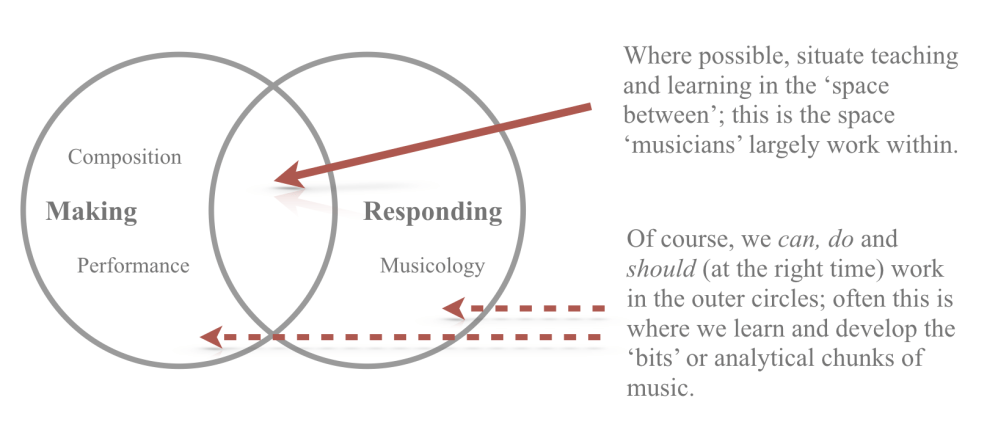
As suggested in the diagram above, we can, do and should work in the outer circles; often this is where we learn and develop the ‘bits’ or analytical chunks of music. At times we work exclusively on one side (both sides), but we need to ensure they meet in the middle to inform knowledge and understanding. It is in this ‘space between’ that we take form one to inform the other or consider what we have made. ‘In between’ we investigate and we are influenced; we move from exploration to enactment.
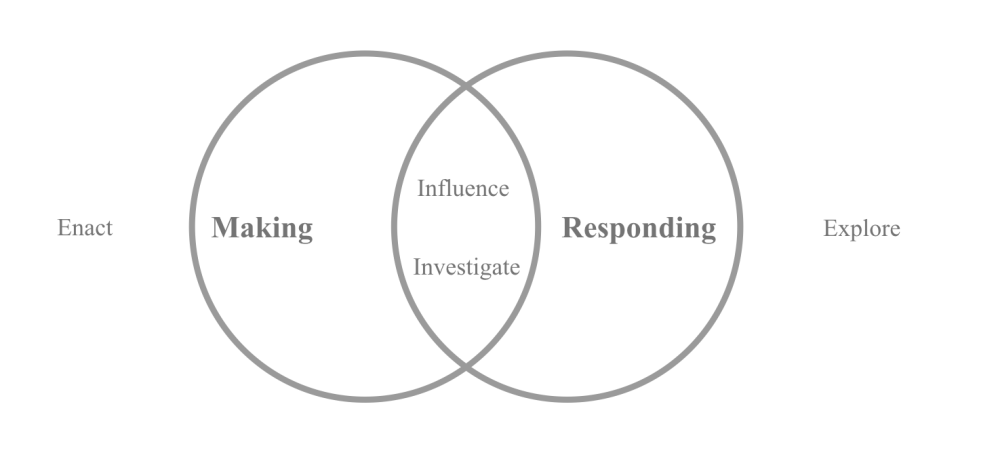
This relationship is quite pronounced in the IA3: Integrated Project[vi] of the new syllabus, but I want to make the point that we do not have to wait until assessment to integrate and consider the interrelationships between making and responding. If we do, we are really dismissing music as a form of discourse and limiting the relationship between intuitive and analytical musical knowledge – this is where true understandings of music are made.
In the very first unit, Designs[vii], students make and respond to music as they explore music elements and concepts to gain greater familiarity with the way music is designed vertically and horizontally. They develop a greater awareness of the stylistic considerations that inform the music they compose and perform (two assessed processes of the unit) and develop an understanding of the interrelationships between these elements in the resolution and realisation of cohesive music. This description provides us with plenty of opportunity to work musically in the ‘space between’. Below is one way that this may be achieved; it is a brief step-through my current Year 11 unit (also entitled Designs). This would be very easy to ‘take into’ the new syllabus… remember what I said about labels? All of this can be easily adapted to suit the new objectives/processes.
In this unit, the design of music becomes the ‘frame’ to talk about the music elements and where they are situated in a piece of music (which we may call the whole ‘house’). Within this analogy, duration is the linear foundation; pitch is the vertical frame – all of the other elements are housed by these. Our focus in on the musicological ‘sayings’ of the pieces we analyse and how our (in this case) performance may be influenced by this. There are some main phases of this presented below.
The very first activity is to learn Ben Lee’s Catch My Disease as a class – aurally. No sheet music, chord charts… just the sound. We spend an entire week on this, and by the end of the week we play it in its entirety. In the later stages of the week we start to talk about the piece and how it is built, these knowledges and understandings are seen in an analysis later on. The students work musically throughout this process, and from experience assign analytical labels to musical practices; learning is situated in practice. Our analysis is eventually captured on this worksheet, done collectively as a class through a ‘sticky note’ process I’ve outlined before (see Encouraging ‘deeper listening’ and own thinking about and of music). This is repeated in the second week with an arrangement of Peter Sculthorpe’s The Settlement from Port Essington. In both analyses we only work with the lower level objectives (processes), we are not so concerned with what it means at this state (we are focused on use and design).
In the first few weeks the students also commence their own work on their Performance 1 task (which will become FA1: Performance). Firstly, we have a group discussion on performance practices/approaches, and I try to unearth the feelings about performance and ways of dealing with any anxieties. The students also engage in individual rehearsals and masterclasses; we unpack the criteria together (which will become based on the ISMG[viii]), consider the criteria in relation to past-student performances… we practice, practice, practice.
As part of this preparation time, the students draft their performance in front the class. I get them to play the work twice – the first one is audio-visually recorded and I take the recordings and overdub them with narration/commentary on their performance (just a headset with a microphone and GarageBand is all that is required!) for them to listen to and reflect upon using this worksheet. The second time through the class engages in an analysis of this work using this worksheet. This provides me (this year) with 12 pieces for analysis provide by the students, ultimately for the students. As not to place too much demand on the students doing the analysis, I typically get them to work in pairs (one pair on duration, one on pitch, one on expressive devices etc…). We again use the ‘sticky note’ approach to compile and discuss and reflect upon our collective findings. This leads us to a guided discussion about their findings, and the student performing is able to play/sing isolated parts of the music to clarity understandings, uses of elements… connecting aural effect and analytical label.
This process is then repeated again for all of the students, and we add to our analyses of each.
The completed analyses inform the understanding of the performing student’s own piece and also the development of their program notes (which could easily become the performance statement), guided by this worksheet.
Phew, I appreciate that is a tangled description! Just like the process!
With the 12 Year 11 students I have this year, this process took 4-5 weeks; however, the students were engaged in musical processes in both individual and collaborative ways. Making and responding were interconnected and informed one another. The analysis was situated in music that the students were making; these experiences were drawn into analysis; firmer connections were made by students as they engaged in music and then talked about it from this direct experience. Importantly, the students also gained experience performing for an audience, learnt to better deal with nerves (with 4 performances of their work for an audience), and worked collaboratively towards analysis of music (which is one of the C21st skills outlined in the syllabus).
Overall, the unit planning involves me selecting two works (Catch My Disease and The Settlement) and the students bring the rest. Analysis is conducted live, or at least asynchronously, from experience. Performance is our focus, but the language of music(ology) is always present. This is all current practice – it has not been authored for the new syllabus, but it highlights that nothing will really change if we teach music musically. If we continue to ‘music’ and work with the processes we currently employ, we will at most only have to change some of the labels. Irrespective of labels, music is still, and always will be, music.
[i] See https://www.qcaa.qld.edu.au/downloads/portal/syllabuses/snr_music_19_syll.pdf.
[ii] See http://australiancurriculum.edu.au/f-10-curriculum/the-arts/key-ideas/ and the syllabus link above.
[iii] Keith Swanwick (1999), Teaching Music Musically, Routledge.
[iv] I have borrowed this from Keith Swanwick, but it takes on a different meaning here.
[v] ASME’s Secondary Curriculum Kick-Start held at UQ on 24 March, 2018. Slide are available in the Resources page (and are linked above).
[vi] IA3 is the Integrated Project assessment instrument of the new syllabus. Within this, students complete a musicological response that will inform a made component. Refer to pp. 47-54 of the syllabus available at https://www.qcaa.qld.edu.au/downloads/portal/syllabuses/snr_music_19_syll.pdf.
[vii] See from p. 24 of the link above.
[viii] ISMG is an acronym for instrument-specific marking guide from the new syllabus.

 Dr Cade Bonar